November 20, 2026
Could a Fixer-Upper Be Your Path to Homeownership in Birmingham?

The quick answer: For the right buyer, yes. Fixer-uppers usually sell for 20% to 30% less than their market value, and a renovation loan can roll the cost of repairs into one mortgage. If move-in-ready homes in the Birmingham area keep landing outside your budget, a home that needs some updating could be your way in.
A fixer-upper won’t be the right call for everyone. Plenty of buyers want a home that’s ready on move-in day. But homes that need some updating could get you in the door for a lot less.
More buyers are starting to realize it, too. Danielle Hale, Chief Economist at Realtor.com, says fixer-uppers give buyers a way into a market where affordability is still stretched, along with the chance to make a home truly their own.
If that sounds like you, here’s why a fixer-upper could be worth a closer look.
Why Is the Price Tag Usually Lower?
Because these homes need work, they tend to have a lower asking price up front. Here’s what that could look like. KCM applied a 25% discount, the middle of that range, to the national median home price from the National Association of Realtors (NAR). This is an example, not the average price of a fixer-upper, but it shows the savings could top $100,000.
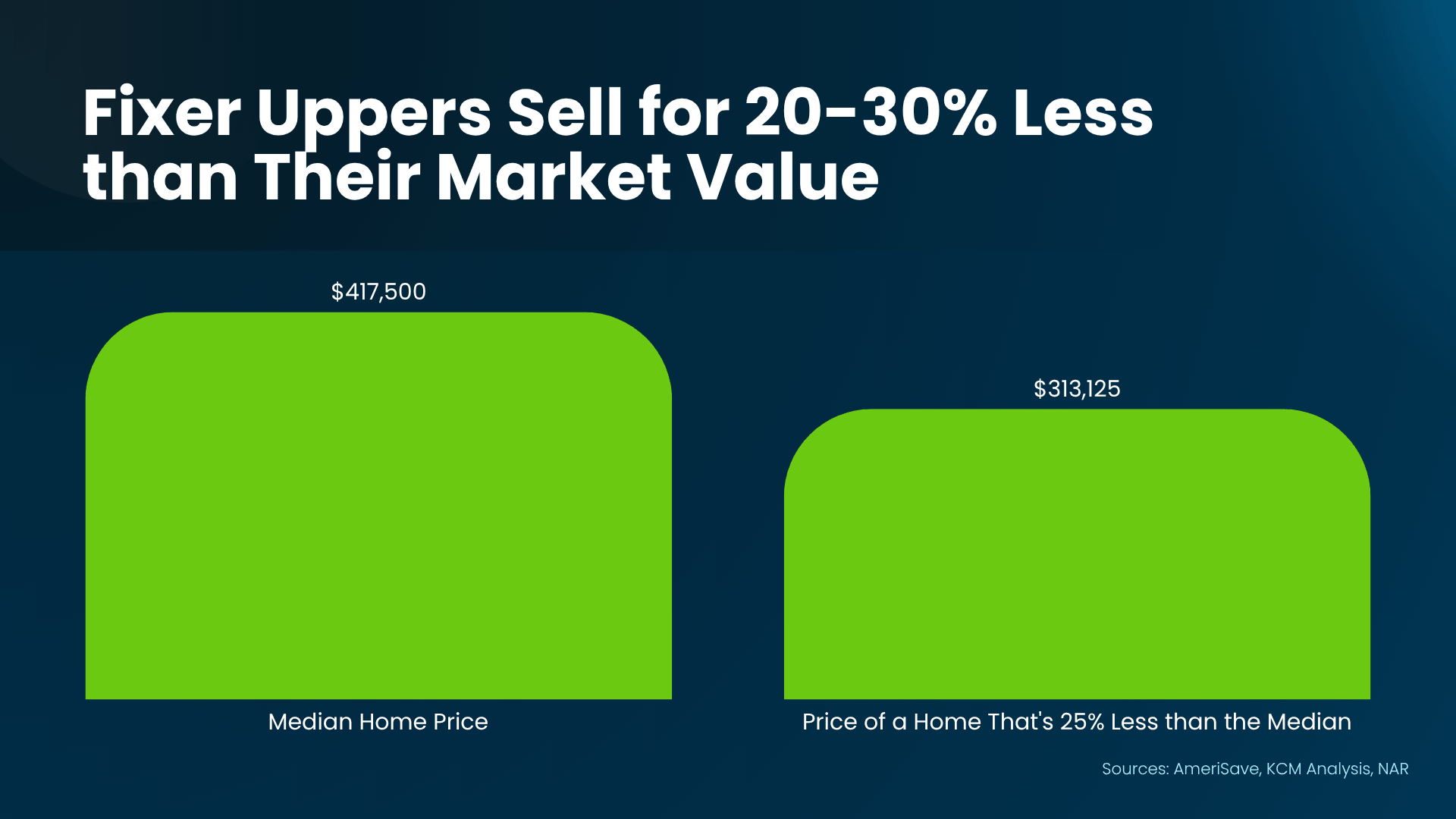
National example using the NAR median home price. Sources: AmeriSave, KCM analysis, NAR.
That’s a big difference up front, and it could be what gets you into a home today. And odds are you don’t have to tackle all the repairs at once. You can space them out over time as it works for you.
Just remember that repair costs can add up quickly and eat into those savings if you don’t plan ahead. So, before you make an offer, get estimates from a contractor and set a repair budget you’re comfortable with. Older homes can hold surprises, so a thorough inspection matters, too. There are even some loan types designed to help pay for the work.
What Does a Fixer-Upper Look Like in the Birmingham Area?
Prices here start lower than the national median, but they’re still climbing. According to Redfin, the Birmingham metro’s median sale price averaged $312,229 from January through June 2026, up 4.6% from a year earlier, with about 4.3 months of supply.
Apply the same 25% discount to that local number and you get a home priced around $234,000, or roughly $78,000 less. Again, that’s an illustration, not a promise of what any one home will cost. Every house, street, and neighborhood is different, whether you’re looking in Hoover, Vestavia Hills, Homewood, Trussville, Pelham, Helena, Chelsea, or elsewhere in Jefferson and Shelby Counties.
Can a Loan Cover the Home and the Repairs?
Yes. With a renovation loan, you can roll the cost of the work into your mortgage, so you don’t have to cover it all out of pocket once you move in. Here are a few options from FHA, Fannie Mae, Freddie Mac, and the VA:
- FHA 203(k) loans: Lets you buy or refinance a home that’s at least a year old and roll the cost of repairs into a single mortgage. The Standard 203(k) is designed for major renovations, while the Limited 203(k) covers smaller repairs and improvements.
- Fannie Mae HomeStyle Renovation: Lets you finance the purchase and renovation of a home in one mortgage, whether you’re buying a fixer-upper or updating a home you already own.
- Freddie Mac CHOICERenovation: Lets you buy and renovate a home in one mortgage, with as little as 5% down (3% for first-time buyers).
- VA renovation loan: VA borrowers can buy and renovate a home with one loan, though few lenders offer it. Eligible projects are limited, and work must be finished within 120 days of closing.
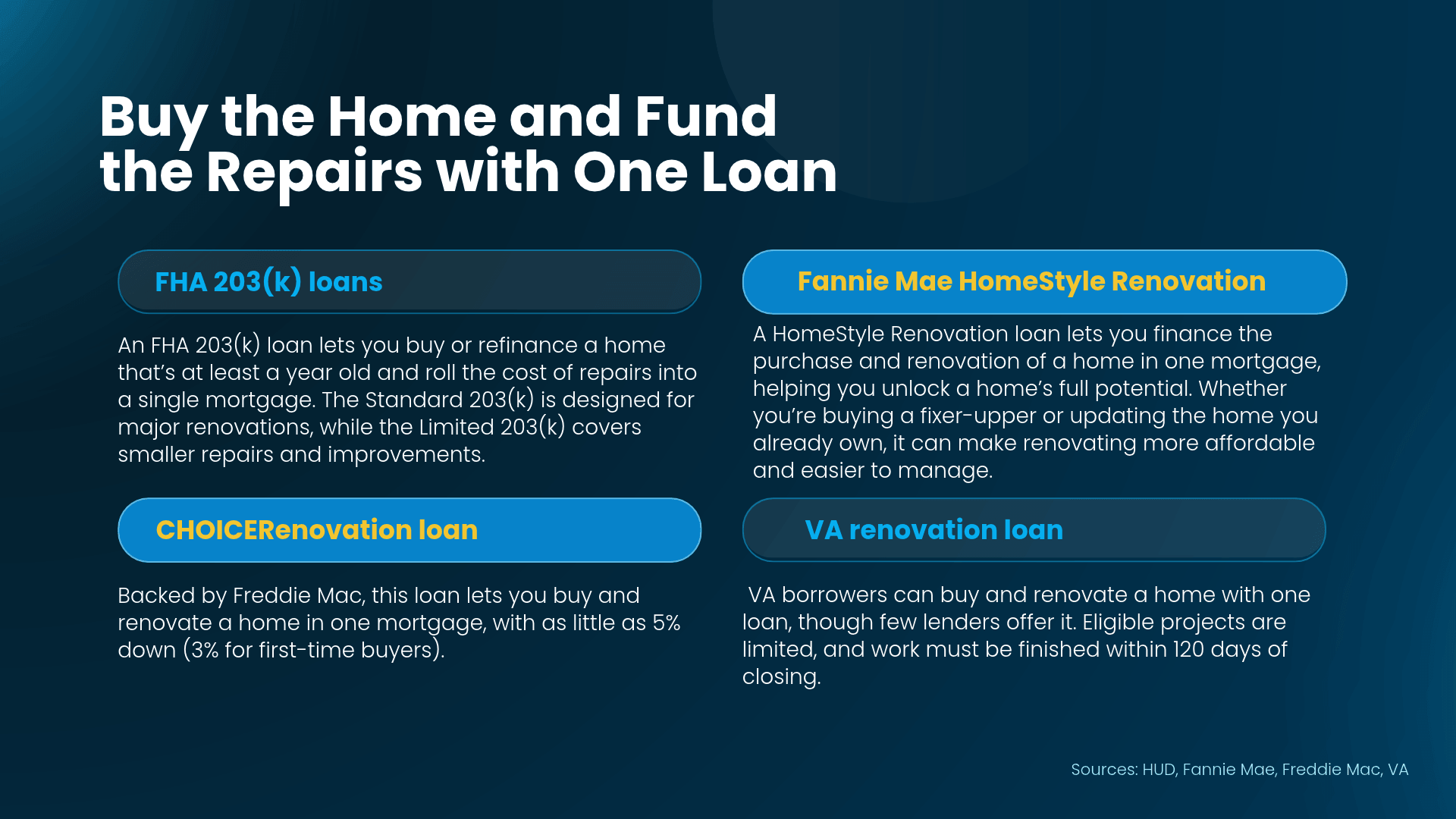
Sources: HUD, Fannie Mae, Freddie Mac, VA.
Each program has its own rules, and not every lender offers all of them. That’s where I come in. I can walk you through which options are available and which make sense for how you plan to tackle updates and repairs over time.
Method Mortgage Insight
Renovation loans come with extra steps, like a repair plan and contractor estimates, so starting early can save you time. If you have a home in mind, or even just a budget, send them my way before you make an offer. We can match the loan to the project before you’re under contract.
Frequently Asked Questions
Q: Is a fixer-upper cheaper than a move-in-ready home?
A: Usually, yes. According to AmeriSave, fixer-uppers typically sell for 20% to 30% less than what they’re worth on the market. Repair costs can eat into those savings, so get contractor estimates before you make an offer.
Q: Can I finance repairs with my mortgage?
A: Yes. Renovation loans such as the FHA 203(k), Fannie Mae HomeStyle Renovation, Freddie Mac CHOICERenovation, and the VA renovation loan let you buy a home and fund repairs in one mortgage. Each has its own rules, and not every lender offers all of them.
Q: Do I have to make all the repairs right away?
A: Not always. Depending on the home and your loan, you may be able to space some updates out over time. Safety and structural issues come first, and some renovation loans set deadlines for finishing the work.
Q: Is a fixer-upper right for me?
A: It can be if you have a clear repair budget, a good inspection, and the right loan in place. It may not be the best fit if you need a home that’s ready on move-in day. We can talk through it together.
Bottom Line
If move-in-ready homes keep coming in over budget, a home that needs some TLC could be your way in. Plan your repair budget and line up the right loan before you buy, and you can get in the door now and make the space your own over time, as your budget allows.
Let’s connect so you can start looking at fixer-uppers in the neighborhoods you love.
Reach out to me, Clyde Prather, Loan Officer at Method Mortgage:
205.447.3079 (direct)
cprather@methodmortgage.com
NMLS# 421706
Related Articles

Here We Go

How to Improve Your Credit Score in 2018